
Mamdani Will Probably Win, and We Need To Talk About Why
The System is terminally broken. Young people are tired of pretending it works.

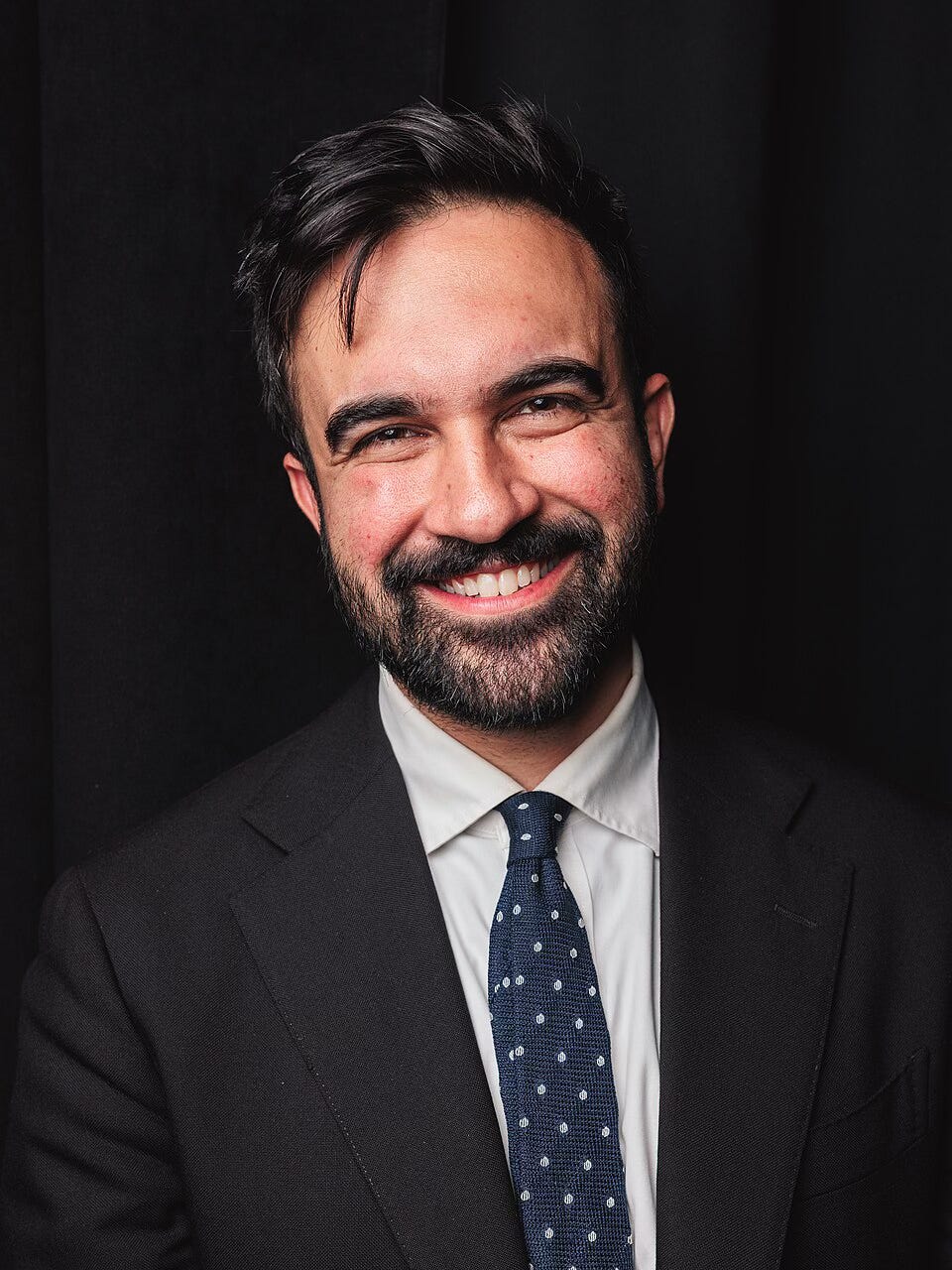
According to recent polling, the unthinkable is about to happen tomorrow. Barring a cataclysmic event, Zohran Mamdani will likely be crowned New York City’s next mayor.
His winning platform? Free city buses, free childcare, city-owned grocery stores, a rent freeze, and a $30 minimum wage by 2030 — all funded by taxing the wealthy. Whether you believe he’s a democratic socialist or a communist, there’s no question that Mamdani has charted a path for the Big Apple that’s fundamentally at odds with a core tenet of the American economy: capitalism.
The Democratic political class has greeted his meteoric rise with a mix of shock and horror. Chuck Schumer and Hakeem Jeffries conspicuously withheld their endorsements for months (Jeffries finally endorsed Mamdani less than two weeks ago, but Schumer is still holding out). Republicans, on the other hand, gleefully predict the demise of Gotham, with Florida Governor Ron DeSantis quipping that a Mamdani win will be “good for Republicans,” but “bad for New York City.”
Mamdani’s rise has even caught the attention of average Americans outside the Big Apple. Many of us have a bad feeling about where this is heading, and not just because we have affection for the City That Never Sleeps. Whether we’re Democrat or Republican, it’s impossible to ignore the symbolic weight of America’s financial capital and most populous city managed by a man who rejects free markets, openly disdains wealthy citizens, and has dreamy-eyed affection for centralized government control.
It’s low-key terrifying.
Yet amid the hand-wringing and jawboning about what’s happening in New York, I’ve noticed far less discussion about why it’s happening. It’s widely assumed that New Yorkers have simply lost their minds. But even if that’s the case, I think it’s worth indulging in a bit of empathy and asking what’s driven them to this state. In the civil discourse space, this is called “steelmanning.”
The Brookings Institution attributes Mamdani’s success to his organizational savvy and “social media mastery.” Senator Bernie Sanders believes Mamdani is the frontrunner because he’s built a “strong grassroots movement around a progressive (to put it mildly) agenda.” The New York Times chalks up his success to his “charisma.”
While these are all valid explanations, I think there’s much more to the story.
Anyone who follows me knows how much I cherish and embrace western values — not because they’re always perfectly executed in practice, but because of what they empower us to accomplish and aspire to. So what you’re about to read isn’t an indictment of classical liberalism or capitalism. Placed against socialism, communism, and all other “isms,” I believe capitalism remains the best vehicle for enabling opportunity for the greatest number of people.
But we all need to be clear-eyed about what’s happening now.
When asked about their top concern, a majority of New York voters repeatedly cited the cost of living, with an alarming 49% declaring the city very unaffordable. In fact, 62% of Mamdani’s voters put cost of living as the most important issue, compared to 22% of Cuomo supporters, 5% of Curtis Sliwa supporters, and 3% of Eric Adams voters.
When you take a deeper dive into Mamdani’s support, something else stands out: it’s coming overwhelmingly from Gens Y and Z. The latest polling shows that 76% of voters over the age of 50 back former Governor Andrew Cuomo; conversely, Mamdani commands the support of 67% of those under 30. Mamdani also has support from the majority of black and Hispanic voters, who represent nearly half of the city’s population (among the latter, cost of living ranks as the major concern).
Understand what this means.
If Mamdani wins tomorrow, it won’t be because of identity politics or cultural grievances. It won’t be because millions of New Yorkers have suddenly been radicalized by the Social Justice Complex. It won’t even be because his economic policies are grounded in reality.
A Mamdani victory will be a referendum on the ability of more than half of the city’s residents to simply survive.
Government data tell us that the U.S. economy is challenged, but still fundamentally strong. The media assure us that we are near — but not officially in — a recession. Yet there’s a world of difference between what’s happening on paper and what’s playing out on the ground.
To put it bluntly, the social contract that’s kept the U.S. economy humming for generations has been revealed for what it truly is: a bait and switch. Millions of people feel betrayed by a System that’s visibly broken and is breaking harder every year and every day. They’re desperate and angry. And when people are desperate and angry, all options are on the table. Even socialism. Even communism.
The System that once received buy-in from younger generations by offering genuine economic mobility has quietly transformed into a shameless vehicle of wealth extraction. And it happened so gradually that most of us barely noticed — because we were too busy buying into a Dream we still believed in. Deep down, of course, we knew or at least suspected that something was off. We saw the red flags. But we were making just enough money to pretend that everything was fine. We talked ourselves into believing the System still worked.
Post-pandemic, that’s changed. Eye-popping inflation, mass layoffs, and unaffordable housing have bitch slapped millions of people who can no longer afford to pretend.
We’ve spent years wringing our hands over threats to our way of life and values. DEI. Woke ideology. Cancel culture. Threats to liberty, capitalism and free speech. Communism. Russia. China. We’ve been so busy fighting culture wars that we’ve missed the elephant in the room: the greatest threat to America is now America, itself.
We built our own guillotine.
The political class, media, and economic “experts” will never admit to it, but the reality is that the U.S. abandoned capitalism in its true form long before many Americans were born. Over the past half century, we’ve quietly migrated to a neo-feudal framework that makes it increasingly difficult for the average person to survive, much less get ahead. It’s a System that rewards business elites in success and socializes their losses in failure, yet penalizes average citizens whether they succeed or fail.
This isn’t capitalism; it’s a Franken-System that our government refuses to even name, because naming it would require acknowledging what it’s done. Instead, it hides behind misleading branding, invoking “capitalism” and “free markets” to defend a predatory framework that bears no credible resemblance to either. It’s like removing the sugar and caramel from a can of Coke, filling it with murky water, and insisting you’re still selling the Real Thing.
But young people aren’t buying it.
The System’s defenders dismiss their economic anxiety as “financial doomerism.” Author and psychologist Jean Twenge accuses Gen Z of “perpetually think[ing] things are awful.” (Twenge also happens to be 54 years old). But do younger generations actually have reason to be pessimistic? Let’s look at the evidence.
Over the past decade, housing has transformed from a source of shelter to an investment vehicle. Millennials and Gen Z have watched the real estate train pull away from the station while they’ve stood helpless on the platform. Only 56% of 35-year-old Millennials own homes, compared to 59.4% of Gen Xers and 61.5% of baby boomers at that age. Given their dismal employment prospects, it’s likely Gen Z will never approach homeownership anywhere near these levels. The typical homebuyer now pays $2,800 per month, an all-time high that’s left an entire generation locked out of wealth building.
But it’s not just housing.
Education became indentured servitude. Millennials and Gen Z owe more than $1 trillion in student loans, with average debt of $39,375 — nearly double what borrowers owed in 2008. A year out, more than half are underemployed (working in jobs that don’t require a college degree); 45% are still underemployed a decade later.
Yet even as tuition has skyrocketed, wages have increased only marginally and nowhere near enough to keep pace with inflation. Essentially, education delivers the same earning power as it did 20 years ago. Any reasonable investor would recognize this ROI for what it is: a scam.
Employment became precarity.
The “be your own boss” gig economy accelerated the demolition of economic security. Stable jobs with benefits gave way to Uber shifts and DoorDash deliveries as companies externalized risks onto workers. But the gig economy is drying up. There are waitlists for DoorDashers, and rideshare companies now take between 40% - 70% of fares. In 2024, the average Uber and Lyft driver earned less than they did the prior year while working more. Young people ping-pong from one desperate hustle to another, one algorithm away from financial catastrophe.
Healthcare became a trap.
This system isn’t designed to keep people healthy; it’s designed to keep them tied to an employer. Employees stay in jobs they hate because leaving means paying $800-$1,000 monthly for insurance, or gambling with their health. Young people can’t even rely on being “young and healthy” anymore; they’re developing cancer and chronic illnesses at alarming rates while insurers increasingly deny coverage for procedures that were routine two decades ago. The assassination of United Healthcare CEO Brian Thompson by a frustrated 26-year-old wasn’t surprising; it almost seemed inevitable.
Even basic human needs like relationships, family, and children are being systematically stripped from young couples. Childcare costs more than the median American worker makes, often forcing one partner to simply not work. Yet as we near demographic crisis, System defenders say the solution is simple: import workers who don’t worry about student debt or healthcare marketplaces that force them to choose between employment and childcare.
The current System actively engineers inequality. And young people aren’t stupid. They can see what many of us missed while we were busy supporting a scheme that rewarded us just enough to play along: the game isn’t just rigged; it feels as though it’s designed to break people.
What’s also becoming clear is that we’re experiencing different versions of reality, especially across generations. Baby Boomers and older Gen Xers who managed to reap the remaining benefits from a decaying System are often reluctant to acknowledge or confront these systemic problems. But America’s youngest generations don’t have this luxury. They’re rejecting a scheme that has nothing left to offer them.
The System is failing some more than others, which keeps us divided against a broken System.
For too long, too many of us have felt handcuffed, but we didn’t see our shackles. Now they’re becoming more visible, especially to the youngest Americans. And once you see your handcuffs, you start looking for any way to get them off. By any means necessary.
I’ll be honest: I’m not looking forward to what comes next because it will almost certainly be chaotic, ugly, and even frightening. But I also can’t help but feel that it’s inevitable and probably needs to happen in order for us to move forward.
We need to start by steelmanning the people we don’t understand. Chastising Mamdani voters won’t solve the challenges we face. Finding a solution will require us to collectively acknowledge the source of a problem that’s affecting more Americans every day. Even if we feel largely immune from what’s happening now, the System mathematically guarantees that eventually all but a very few will be shackled.
Mamdani is a wake up call. If we want to save what’s left of our country, we need to be honest about what we’ve built — and why it’s failing so many Americans.
As an elder Millennial I’m sympathetic to my generation’s raw deal in certain circumstances, doubly so with Gen Z. But turning toward soft communism (guy is taking pages straight out of USSR’s playbook) really does concern me. It isn’t lost on me that so few people of my generation and the next generation are truly educated on the horrors of collectivism.
His administration isn’t going to destroy the city, but I wager that it’ll do enough damage that it’ll take many years to recover.
Let's add the decay of an education system that omitted much of the history you and I were taught. Consider also, the movement that marginalized what middle class we have left...I like to think of it a mile wide and an inch thick. Cheap goods from other countries...further destroying American middle class. The evaporation of religion. The youngsters are voting from bad to worse and based on anger and emotion. What's happening is a full court press to destroy...everything. Sound familiar? Look to the tenets of Marxism, Leninsm, Stalinism, Maoism...add you own "ism" if you like. In the military we call this full spectrum warfare. Heavy emphasis on control of information and PSYOP.
Too much for Monday? I'm just getting warmed up. Be well and find peace even if its for a few minutes.